
From Deadlines to Deliberations
Time to Spare and Wisdom to Share

All my life I have worked full time. Whether that meant fifty plus hours a week at a clinic job or eighty plus in my own private practice, or a hundred plus as a medical resident, it was never really an option to work part time or to create my own schedule.
I have wondered if, after working so much and for so long, whether I would find retirement boring or unfulfilling. I considered whether I would feel strange not filling all of my hours with work-related activities: getting ready for work, improving my work, winding down from work, and planning my vacations from work.
I recently had reason to look up my social security benefits. This tells how much and over what period of time I paid into the social security system and how much I could potentially collect based on the year that I will initiate my benefits.
I realized when poring over the chart that I have actually been working and paying into the system since I was fourteen years old! I was shocked but I had worked as a camp counselor, a waitress, a tutor, then as a physical therapist and of course for the last twenty nine years as a physician. In two of my years in medical school my income was zero and the year I opened my private practice it was pretty close to zero. But every other year on that list, from 1976 to the present, I have been a contributor, paying my taxes and paying into the social security system.
So if now my retirement sometimes means spending hours relaxing or reading or even not doing anything, I remind myself that after working so many hours for so many years, it’s sometimes okay to do nothing. I’m making up for all those years of hard work.
A few months ago I received a jury duty summons. I remembered all the times I had received one in the past. My immediate reaction back then was that “I have no time for this.” And “Jury duty should be for retired people.” I always thought that those were the people with nothing better to do. They can go and sit for hours doing their civic duty. But now I am one of them.
I’m not sure why everyone looks at jury duty with such a sense of dread— like it’s something to be avoided at all costs. But now that I have no job to miss, no hours to make up and no salary to lose— I decided to look at serving on a jury in a different light. I decided to embrace it and even possibly try to enjoy it. I called the given number on Sunday evening to see if my juror badge number was one that was picked to report, and I actually felt myself hopeful while waiting on the line. Of course, my number was picked, and, even better, the report time was at noon. I could be excited about jury duty but I’m not gonna lie, retirement does NOT lend itself to happy early morning wake-ups!
I arrived at the courthouse at ten minutes to twelve, finding a close-by parking spot and proudly placing my JUROR badge on my dashboard. Walking into the block-long white columned court house I remembered that the only other time, thankfully, I had been in this building was the last time I was called to jury duty, four years ago. It wasn’t a bad thing to be unfamiliar with the courts. Since moving to California I’ve never had a legal problem or even a traffic ticket. I passed through the metal detectors and followed the signs to the main auditorium where all the potential jurors were to gather. There were easily more than one hundred and fifty people in that room. I was aware that since I live and have worked in this small town, it would be likely that I knew several if not many of the people sitting here.
(I often see people who have been my patients when I’m out and about, see https://drrebeccalevy.substack.com/p/the-quiet-privilege-of-being-known).
I took a seat, ready for a long afternoon. I remembered my last jury duty assignment so I had come prepared: phone charger, two books downloaded onto my Kindle, water, snacks, tissues and cough drops. I was ready.
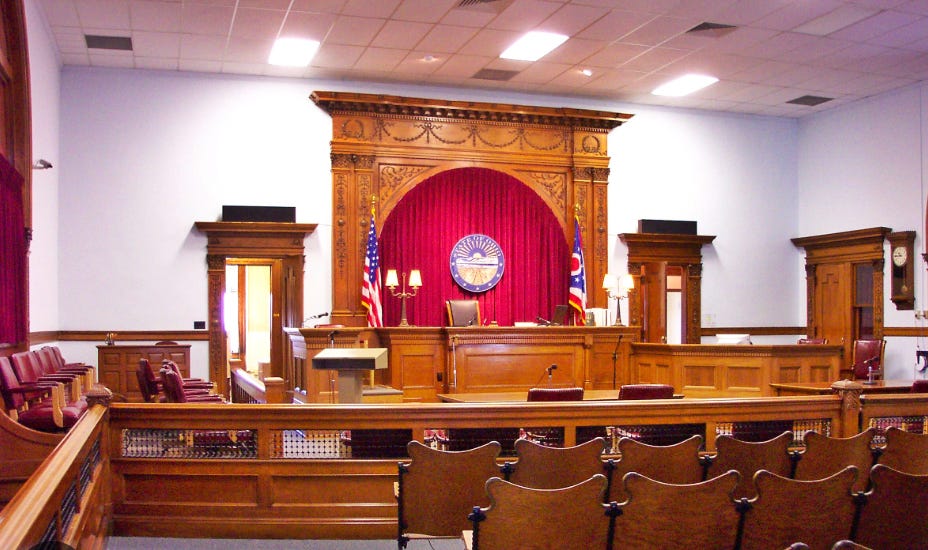
After an hour, the clerk started calling names for attendance. She made a few announcements and had us all raise our right hands and promise that we would do this job to the best of our abilities, and decide a case strictly on the evidence. She then said, “All the names I now read please stand and follow the woman at the back.” She read off about seventy or so names and we all started following another clerk out the door and to the criminal courthouse across the street. We reconvened in a courtroom that had a twenty seat jury box and a gallery where the rest of the seats faced the judge’s bench. Already in the room were the judge, a serious looking woman in her fifties; two attorneys, one woman, the prosecutor, and one man, for the defense. Another man sat with the defense attorney. I assumed he was the defendant.
The judge introduced herself, and introduced the attorneys. She thanked us for our service and explained a little about the whole process that we were going to follow. She said that she was very conscientious about explaining everything and about taking breaks so that everyone could use the bathrooms and eat and drink during the day, but she was here to make sure all of the rules were followed.
The judge then began to read from the list of charges that were the allegations in this case. They were of a sexual nature and involved minors under the age of ten. I looked around. Some people were listening intently, some were on their phones. At least one was already asleep, and two or three looked like they were in distress, sad or crying at the mention of some of the details of the alleged crimes. For the next several hours we were all to go through the painstaking process of picking the jury.
The judge then asked the entire assembly of potential jurors to raise a hand if they had ever been the victim of sexual abuse or of child molestation. Clearly almost half of the people sitting there had been. Although I was familiar with those statistics, this process—having people to my right and left raise their hands and have to remember or relive their traumas all in the same moment made the air in the room change. This collection of strangers, shifting in uncomfortable chairs were now people from my town, carrying histories that they hadn’t intended to reveal in a group setting. It was deeply unsettling.
The judge, and then both attorneys asked multiple and repetitive questions of every single potential juror. Many of them raised their hands when asked who believed they would be unable to remain “fair and impartial” given the charges that had been announced. One by one, the judge decided whether each juror had enough of a reason to be dismissed or excused from jury duty. Some jurors publicly declared the reasons for their perceived inability to serve. Over half elected to talk to the judge in private to elaborate. Some left in tears, clearly shaken by having to recount a past injustice. By the end of the day, there were about half the number of people left. There were twenty in the jury box, including me (I was juror number eleven at this point) and the rest still in the gallery.
It was obvious in the room that most of the potential jurors and even the attorneys, thought jury duty was somehow a burden to try to evade. One of the attorneys, upon dismissing a candidate, said “Congratulations. You’ve won a pass.” That landed poorly with me. If the attorney was declaring that jury duty was an inconvenience to be granted a ‘pass’ from, how would ordinary citizens believe that it was to be a source of pride and a civic responsibility? I totally understand the difficulty for people that are the sole owner of a business (that was me just one year ago) or the lone source of income to a family. And I certainly understand those who feel the trauma of a personal experience would be too much to allow them to listen to testimony that may re-traumatize them. But what about all the others? So many people listed inconveniences or local plans as reasons that they could not serve on this jury. But shouldn’t we all have a vested interest in the outcome of a criminal trial taking place in our own back yard? I thought the judge was sympathetic but strict in her decisions.
Everyone says they want a fair and proper system of justice. But if we have so much difficulty seating twelve jurors out of over a hundred candidates who will provide the justice?
Through day one and day two of jury selection, I remained in the jury box. I was surprised that no one decided that my background and the fact that I work as an expert witness for the California Medical Board would disqualify me. I came back on day three excited to get started on the case. Maybe I would even be the jury foreman!
However, first thing in the morning on day three, the judge asked both attorneys if they wanted to use their peremptory challenges. During jury selection, attorneys can ask that potential jurors be dismissed without stating a reason to the court. The prosecutor went first, and she said “I pass.” Then when the defense attorney spoke he said, “We dismiss juror number eleven, Dr. Levy.” I almost didn’t hear him, so sure was I by now that I was going to sit on this jury. I sadly got up to leave. My civic duty was over. The judge said “Thank you for your service.”
When I walked through the door, the bailiff approached me, “Do you need a slip for work?” He asked. To which I said, “Definitely not. I’m retired.”
Maybe next time.
Timely topic: From Deadlines to Deliberations. Unfortunately, I had to reschedule my date for jury duty from February to July 2026. It’s great to hear about your jury duty experience. I’m sure I won’t qualify as a juror, though, because I’m far too liberal to be objective.